
The Second Interruption
This is a follow-on to Sorry... Can I Just Finish? - part two on interruption, voice and power.
The most powerful interruption doesn't happen in the meeting. It happens afterwards.
Someone interrupts you. You stop speaking. The meeting moves on.
Nothing unusual there.
But then something else happens. Not in the room. Inside your own head.
"I should have said something."
"It's too late now."
"Maybe they were right."
"Don't make a fuss."
"You'll sound defensive."
"Just leave it."
The first interruption lasted a few seconds.
The second can last for years.
We Become The Person Who Interrupts Ourselves
One of the saddest things I see in leadership is not people being silenced by others.
It's people who have become so accustomed to being interrupted that they begin interrupting themselves.
The thought arrives. Then disappears. The question forms. Then gets edited. The challenge feels important. Then gets swallowed.
Not because they lack judgement. Because somewhere along the way they learned that speaking carried a cost.
Eventually, nobody else needs to silence them. Their own internal broadcaster does the job - muting their voice to spare them the risk of speaking up.
Radio Bollocks
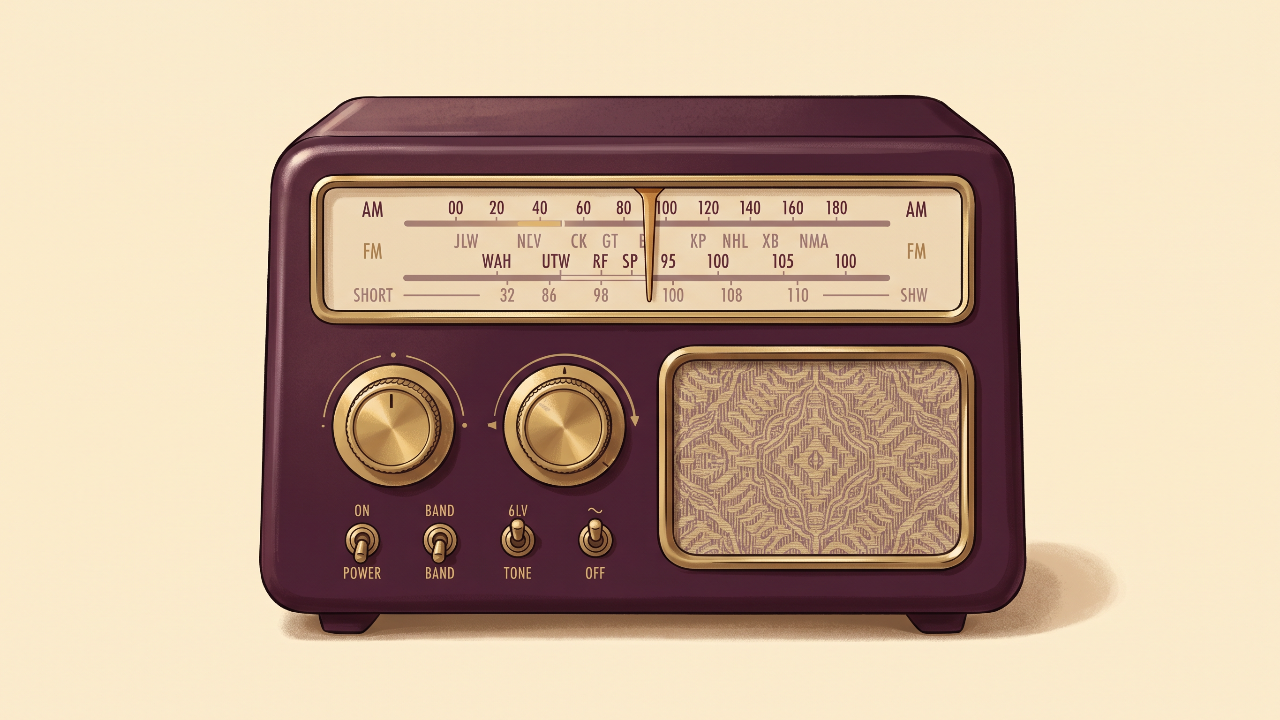
At PowerVox, we have an affectionate name for that negative inner voice. We call it Radio Bollocks.
That relentless internal station, broadcasting on repeat:
|
♬ NOW PLAYING — RADIO BOLLOCKS "You're overreacting." "Don't embarrass yourself." "You haven't thought this through." "Someone else will say it better." "Why on earth did you say that?" |
Here's the important thing.
Those thoughts often sound like your own voice. But they are not necessarily your judgement.
They are old broadcasts. Conditioned responses. Protective strategies. Learned once upon a time - or through a series of hard moments.
And because they were learned, they can also be questioned, challenged and unlearned.
Self-Doubt Is Often Self-Protection
We're quick to label that negative inner voice. Self-doubt. Imposter syndrome. Lack of confidence. Self-sabotage.
At PowerVox, we think it's better understood as a set of intelligent adaptations.
If every time you challenged authority you were dismissed... if every mistake was punished... if every disagreement carried consequences...
Wouldn't your nervous system learn to keep you safe? Wouldn't it begin whispering: "Stay quiet. Wait. Don't risk it."
The problem is that what once protected you can eventually imprison you.
The Cost Of Self-Abandonment
Every time we ignore our own judgement, something small happens.
Trust erodes. Not trust in other people - trust in ourselves.
We begin to wonder whether our instincts are worth following. Whether our perspective matters. Whether our voice belongs in the room.
The irony is painful: the very strategy designed to protect us gradually disconnects us from ourselves.
The Next Right Thing
PowerVox has never been about speaking up at any cost.
Sometimes silence is wise - we call it strategic silence. Read the room, receive the signal, make a choice. Sometimes timing matters. Sometimes courage is the act of waiting, and choosing the moment.
So the question we ask is different. The question is: what is the next right thing?
Perhaps it's returning to the point later in the meeting. Perhaps a different question. Perhaps a one-to-one conversation afterwards. Perhaps an email. Perhaps - eventually - deciding that this environment is no longer one in which you can flourish.
Voice Intelligence is not measured by whether you spoke in any particular moment. It is measured by whether you stayed connected to your judgement, your truth, your emotional intelligence.
Turning The Dial
The breakthrough often begins with one simple realisation:
I am not my thoughts. I am the thinker of my thoughts.
That small shift can change everything where Radio Bollocks is concerned. Because suddenly you notice the broadcast. You recognise the station. You realise you've been listening to Radio Bollocks again.
And you remember that you can turn the dial.
Not towards false positivity. Towards truth.
|
♬ TUNE TO — WHAT'S ACTUALLY TRUE "I have something worth contributing." "I don't need certainty to ask a question." "I can survive disagreement." "I don't have to abandon my own truth to belong here." |
A gentle note, because this matters. The inner critic I'm describing is the everyday, situational kind - the one that flares in a meeting and fades. If yours is relentless and genuinely distressing, colouring how you feel about yourself most of the time, that's worth talking through with someone qualified - a GP, a therapist, a coach. Turning the dial is a skill, but no one should have to do the deeper work entirely alone.
Leadership Begins Here
Many leadership programmes teach people how to speak. Far fewer help people recognise the moment they stopped trusting their own voice.
Yet that is often where the real work begins. Not with projection. Not with presentation skills. But with rebuilding the relationship between your judgement and your voice.
Because before anyone else hears us... we have to stop interrupting ourselves.
And perhaps the most courageous act of leadership is not finding your voice.
It is choosing - or learning, or relearning - to believe it.
Curious where your own voice stays available, and where it goes quiet? You can take our VQ Assessment here (opens in a new window) — it measures all six dimensions of your Voice Quotient™.
We hope you've enjoyed this blog post. If you're interested in working with PowerVox you can email us [email protected]. Learn more about The Greenhouse at https://www.powervox.co.uk/the-greenhouse. To find out more about PowerVox Play Sessions, visit https://www.powervox.co.uk/studio-play. You can also follow us on social media, using the handles at the footer of our website.