

Nature Figured Out Leadership 400 Million Years Ago
A note on how we see the world at PowerVox - and an open invitation to test it.
Here at PowerVox, there's a question we love to return to, again and again, in our work:
What conditions allow healthy systems to flourish?
Whether the system is a human being, a team, an organisation, a community, a forest, an economy or a democracy - the patterns turn out to be remarkably similar.
A quick word before we begin. What follows is a worldview, not a finding. It's a lens we look through, drawn from ecology and systems thinking, and we hold it as a set of hypotheses we are genuinely excited to test rigorously with our academic partners - not as settled science. Read it as "here is how we think," not yet "here is what we have proven."
And it begins with something nature worked out a very long time ago. The first partnerships between plants and fungi - the underground networks through which trees still share nutrients and information today - are visible in the fossil record from around 400 million years ago. Long before boardrooms and org charts, living systems had already discovered how to sense, share and adapt. We're still catching up.

1. A successful ecosystem is not one where everything is strong
That's the first misconception. Most people imagine successful ecosystems are defined by high performance, efficiency, productivity, growth.
Nature would disagree.
The most resilient ecosystems are rarely the most efficient. They are the most adaptable. A rainforest is resilient because it contains enormous diversity. A monoculture crop field is efficient - but fragile. One disease can wipe it out.
Relevant to organisations, don't you think? Many optimise relentlessly for efficiency.
Few optimise for resilience.
2. Diversity is not a moral issue. It's a survival issue.
This is where we think many organisations get lost.
Nature doesn't value diversity because diversity is nice. Nature values diversity because diversity creates options. Different perspectives. Different behaviours. Different responses. When conditions change, somebody in the ecosystem usually knows what to do.
A homogeneous ecosystem becomes vulnerable. And the same, we'd argue, applies to leadership teams.
If everyone thinks alike, you don't have alignment.
You have fragility.
3. Information must flow
This may be the most important principle of all.
Every successful ecosystem depends on information moving:
Roots exchange nutrients.
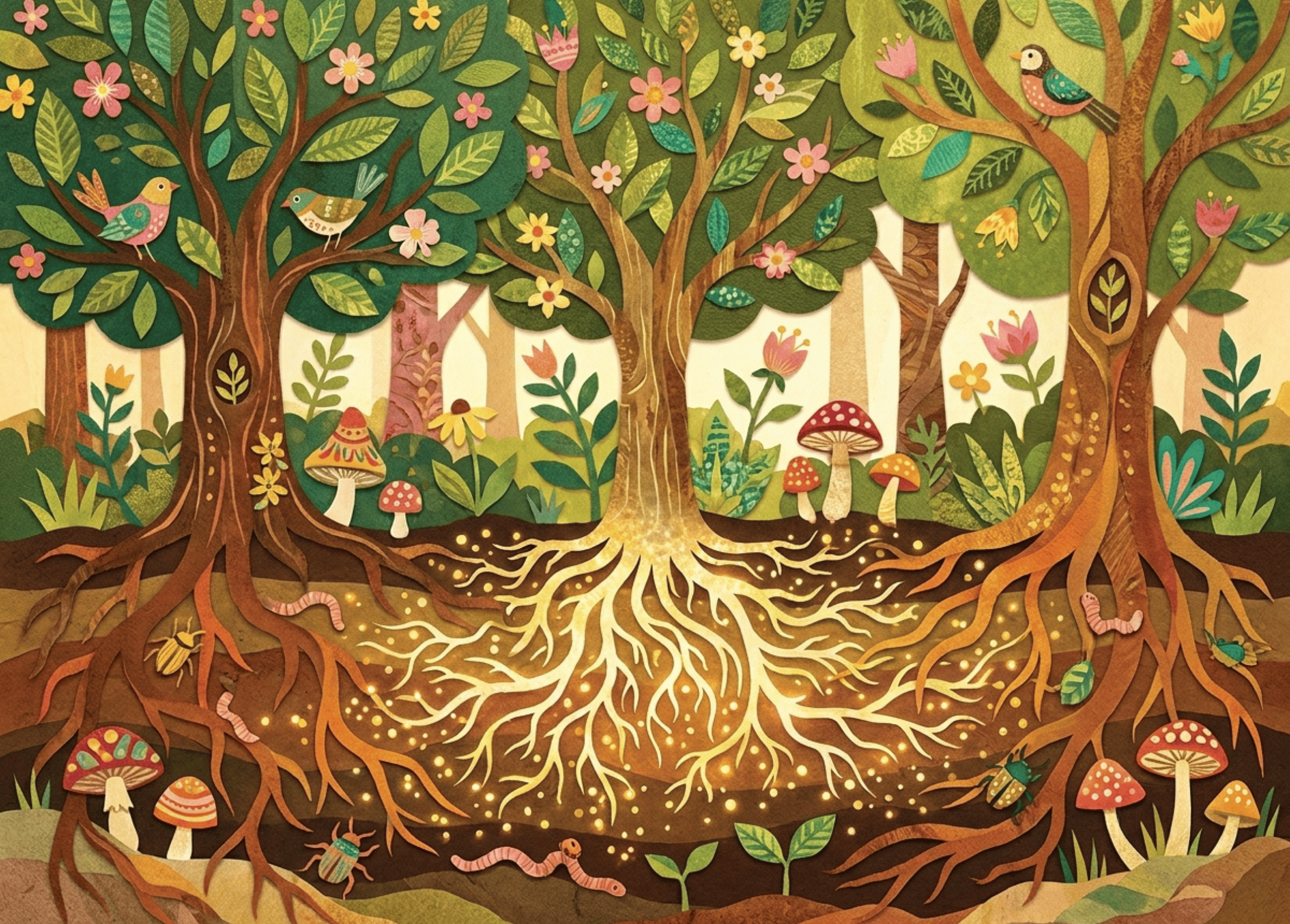
Trees communicate through fungal networks.
Ant colonies coordinate.
The immune system signals.
Markets, teams and families communicate.
When information stops flowing, disease spreads, threats go unseen, opportunities are missed, and adaptation slows.
Sound familiar?
This is why, in our work, we think of voice as more than expression. We think of voice as information flow - and it connects directly to the dimension within our Voice Quotient measurement that we call Signal. In an individual, Signal is the capacity to notice what others miss and to name it. Scale that up, and an organisation's health depends on the same faculty operating collectively: can truthful signals actually travel through the system? The organisation becomes healthier when accurate information can move.
4. There must be psychological safety
Nature has an equivalent. In healthy ecosystems, feedback is not punished - so the system can self-correct. If every signal is suppressed, the ecosystem goes blind.
Picture employees afraid to speak, scientists afraid to challenge, governors afraid to question, children afraid to tell the truth. The system loses its capacity to sense.
The danger isn't silence itself. The danger is the loss of feedback loops.
(This is one of the hypotheses we are most focussed on studying formally - how voice, signal flow and psychological safety actually relate. At this time it's a rich question, not a proven mechanism.)
5. Every ecosystem needs boundaries
People often mistake healthy ecosystems for unrestricted ones. They're not.
Forests have edges. Cells have membranes. Organisations have governance. Families have rules. Boundaries create identity - without them, there is no system. But without permeability, there is no growth.
The art is balancing both. Too rigid and you get stagnation. Too loose and you get chaos.
6. Energy must circulate
Nothing healthy hoards indefinitely.
Water cycles. Nutrients cycle. Money, knowledge, leadership and opportunity all circulate. When resources become trapped, corruption emerges, power concentrates, stagnation sets in.
Healthy ecosystems distribute value. Unhealthy ecosystems extract it. The wheel only spins if participants benefit.
7. There must be room for emergence
This is where most strategic plans fail.
The future cannot be fully predicted, and healthy ecosystems leave space for surprise: innovation, mutation, experimentation, play, growth. Nature doesn't operate through rigid project plans and Jira boards. It operates through countless small experiments. Some fail. Some flourish.
We try to stay close to this principle. Our Greenhouse, for example, is deliberately not a curriculum. It's a living, changing environment, led by the needs of its members. That's an ecosystemic idea at heart.
8. Successful ecosystems balance three tensions
Ultimately, we think the answer reduces to three balancing acts.
|
Stability ↔ Adaptability Too much stability: bureaucracy, stagnation. Too much adaptability: chaos, burnout. |
|
Individual ↔ Collective Too much individual focus: ego, competition. Too much collective focus: conformity, groupthink. |
|
Efficiency ↔ Resilience Too much efficiency: brittleness. Too much resilience: waste. |
Healthy ecosystems constantly rebalance these tensions. They are never finished.
The PowerVox version
If we had to reduce our worldview to a single line, it would be this:
|
A successful ecosystem is one where truthful signals can move freely enough for the system to learn, adapt and flourish. |
Everything else follows from that.
Trust. Innovation. Inclusion. Learning. Performance. Resilience.
Those are outcomes. The mechanism underneath them, we believe, is signal flow.
Which leads us somewhere that still slightly surprises us to say out loud: PowerVox isn't really a communication model. We've come to think of it as a way of looking at organisational ecology - with voice as the pathway through which a system senses itself.
Our work at this time focuses on corporate organisations and women's leadership, but the same patterns seem to show up in boardrooms, schools, communities, families and the natural world. They are all, in the end, ecosystems trying to hear themselves clearly enough to thrive.
And whether that holds up is exactly what we intend to find out - carefully, and with good people who will challenge us.
If that's a question that interests you too, we'd love to hear from you. Join our ecosystem exploration.
We hope you've enjoyed this blog post. If you're interested in working with PowerVox you can email us [email protected]. Learn more about The Greenhouse at https://www.powervox.co.uk/the-greenhouse. To find out more about PowerVox Play Sessions, visit https://www.powervox.co.uk/studio-play. You can also follow us on social media, using the handles at the footer of our website.