
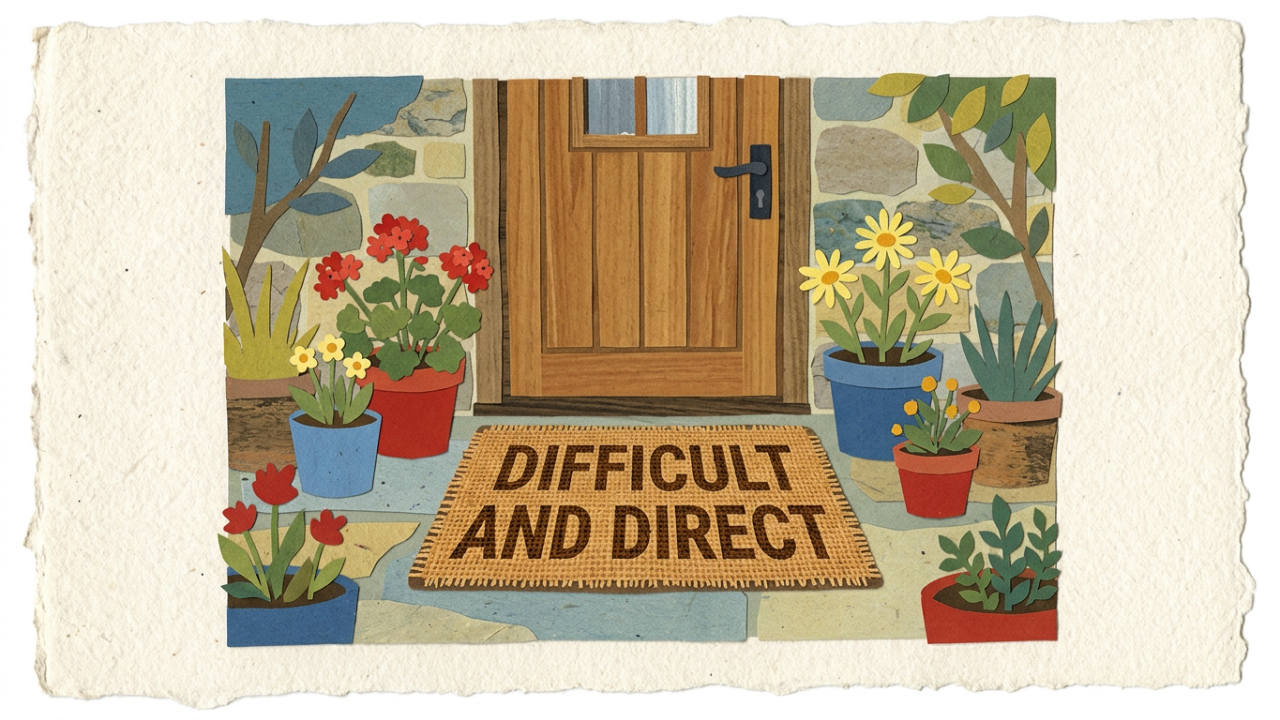
From Doormat to Difficult
"I myself have never been able to find out precisely what Feminism is: I only know that people call me a Feminist whenever I express sentiments that differentiate me from a doormat or a prostitute."
Rebecca West, "Mr Chesterton in Hysterics", The Clarion, 14 November 1913
Rebecca West wrote those words in 1913.
More than a century later, the language may have changed... but the sentiment has not.
Women are unlikely to be told in a performance review that they have failed to behave sufficiently like a doormat. But they may be told that they tend to be perceived as difficult, or "too direct". Negative. Too emotional. High maintenance. Not solutions-focused enough.
That they need to be more resilient. More proactive. More commercial. Less sensitive.
Or perhaps that most slippery of criticisms:
You have a victim mentality.
Often these judgements arise at a very particular moment.
For example, when a woman has tried to describe something about the conditions in which she is working. Perhaps the project structure is dysfunctional — decision-making is unclear, or happening in a disparate way. She is repeatedly talked over. Her expertise is being sought but not acted upon. She has accountability without authority. Expectations are contradictory. Information is being withheld.
Someone else keeps receiving credit for work she has done.
The culture rewards aggression but penalises her when she adopts the same behaviour.
She has raised the issue once. Then twice. Then more carefully. Then with evidence. Then with solutions.
And eventually the conversation changes.
Not: Is what she is describing true?
But: Why is she struggling with it?
That shift matters. Because it relocates the problem.
What began as information about the system or the environment becomes information about the woman.
At PowerVox, we call this diagnostic inversion.
A person describes a problem in their environment and, instead of examining the environment, we begin diagnosing the person describing it.
- Perhaps she needs more confidence.
- Perhaps she needs coaching.
- Perhaps she needs to build more resilience.
- Perhaps she needs to communicate differently.
- Perhaps she needs to take greater ownership.
Some of those things may even be true.
But notice what has happened.
The organisation has moved from asking:
What is happening here?
to asking:
What is wrong with her?
Rebecca West recognised the move in 1913.
Express sentiments that differentiate you from a doormat, and someone will find a label for you.
Today the labels are simply more sophisticated.
"Try harder" is not always development
One of the most common responses women receive when they are struggling to create impact is some version of:
- Speak up more.
- Be more confident.
- Build your profile.
- Take up more space.
- Stop overthinking.
- Be more proactive.
There is nothing inherently wrong with any of that advice.
The problem comes when it is offered without examining the conditions into which the woman is being asked to speak.
Because voice is not simply an individual act.
Voice is relational.
It exists between a speaker and a listener. Between expertise and power. Between what someone says and what the environment permits others to hear.
You can develop a person's ability to communicate with extraordinary precision and still place them inside a system in which their contribution carries less weight.
You can teach someone to speak more clearly while doing nothing about the meeting in which they are routinely interrupted.
You can coach someone to be more assertive while leaving untouched the double standard that reads identical behaviour as decisive in one leader and abrasive in another.
You can increase confidence while failing to increase consequence.
And eventually the message to the woman becomes:
If your voice isn't landing, you must not be using it properly.
That is an extraordinarily convenient conclusion for an organisation.
Not every uncomfortable woman is a dysfunctional woman
There is another reason this matters. People who articulate dysfunction are often uncomfortable to have around.
- They interrupt the story an organisation tells itself.
- They notice inconsistencies.
- They ask the question everyone else has quietly agreed not to ask.
- They identify the gap between the values on the wall and the behaviour in the room.
- They say, "This isn't working," while everyone else is still discussing how to optimise it.
That can look like negativity. (Sometimes it is negativity, or frustration.) Sometimes someone really is refusing responsibility, externalising every problem, or making themselves powerless.
But good leadership requires the ability to distinguish between those things.
Because the opposite error is dangerous too: mistaking accurate observation for poor attitude.
An organisation that habitually does this eventually trains people not to tell it the truth. The most perceptive people learn to self-censor. The politically astute learn which subjects are safe.
The exhausted leave.
And the organisation congratulates itself, because everyone remaining appears remarkably aligned.
The cost of making women easier to manage
There is a deeper tension here for organisations investing in women's leadership programmes.
What exactly are we developing women for?
To contribute more of what they know?
Or to become easier to accommodate within the existing system?
Those are not always the same project.
There is a version of women's leadership development that unintentionally teaches adaptation:
- How to sound confident enough.
- How to navigate difficult personalities.
- How to influence without authority.
- How to manage your emotions.
- How to build resilience.
Again, all useful capabilities.
But if that is where the work stops, something important gets missed.
Sometimes the woman does not need to become more resilient to the environment. Sometimes what the organisation needs is to become more responsive to what she is telling it.
That distinction feels increasingly important to me, and it is at the heart of what we do at PowerVox.
Because the purpose of developing women's voices cannot simply be to produce women who are more skilled at surviving conditions that should themselves be questioned.
Voice is information
This is one of the reasons I think organisations need a more sophisticated understanding of voice.
When someone speaks, they are not simply demonstrating a communication skill.
They are transmitting information.
- About the work.
- About the customer.
- About risk.
- About culture.
- About a decision that does not make sense.
- About something people closer to power may not be able to see.
The question, therefore, is not merely:
Can she speak?
It is:
Can the organisation hear?
And beyond that:
Does what she knows reach the decisions that need it?
That is a very different leadership question.
It shifts our attention from fixing the speaker to examining the whole transmission system.
Who speaks?
Who is believed?
Who gets interrupted?
Whose hesitation is interpreted as lack of confidence?
Whose certainty is treated as competence?
Whose dissent is valued?
Whose dissent is pathologised?
And whose expertise quietly disappears between their brain and the decision?
From doormat to difficult
Rebecca West's sentence is funny because it is outrageous.
But its durability should make us uncomfortable. It's worth a little bit of history too - West's line is from "Mr Chesterton in Hysterics," The Clarion, 14 November 1913, reprinted in The Young Rebecca (1982). She was twenty, and she wrote it in the middle of dismantling G.K. Chesterton for calling the women's movement a procession blocking the march of modern men - which is to say she was being labelled precisely for naming a dysfunction accurately.
The "acceptable" woman has always occupied a strangely narrow corridor.
- Do not be passive. (But do not be troublesome.)
- Speak up. (But choose your moment.)
- Challenge. (But constructively, and usually in private.)
- Be confident. (But not intimidating.)
- Advocate for yourself. (But do not appear entitled, or whiny.)
- Raise problems. (But arrive always with the solution.)
And above all, do not make the people around you too uncomfortable.
Perhaps that is why West's doormat still feels so contemporary.
The modern workplace may no longer demand female silence explicitly.
Instead, it can reward a more subtle form of compliance: voice, provided the voice does not seriously disturb anything.
And that is where we need to become much more curious.
The next time a woman is described as difficult, negative, high maintenance, emotional or insufficiently resilient, perhaps the first question should not be:
How do we help her change?
Perhaps it should be:
What has she been trying to tell us?
Because sometimes the person creating discomfort is not the problem in the system.
Sometimes she is the person who can see it — and is brave enough to voice it.
And when she is heard, and when we work to fix what she has seen, what then becomes possible for that wider environment?
That is a question for another day.
Before you go
If something here has landed - a room you have sat in, a word you have been handed in a review - it is worth looking at properly rather than carrying about.
The PowerVox VQ Assessment reads voice intelligence across six dimensions: Presence, Signal, Clarity, Authenticity, Conviction and Impact. What comes back is a reading of your current status on how powerfully you feel able to use your voice in the environments that you live and work in. It's our springboard to help you build a stronger voice as part of your leadership growth.
And if you are reading this from the other side of the table - as someone who has recently described a colleague as difficult - the question this blog post ends on is the one we'd love you to reflect on today.